
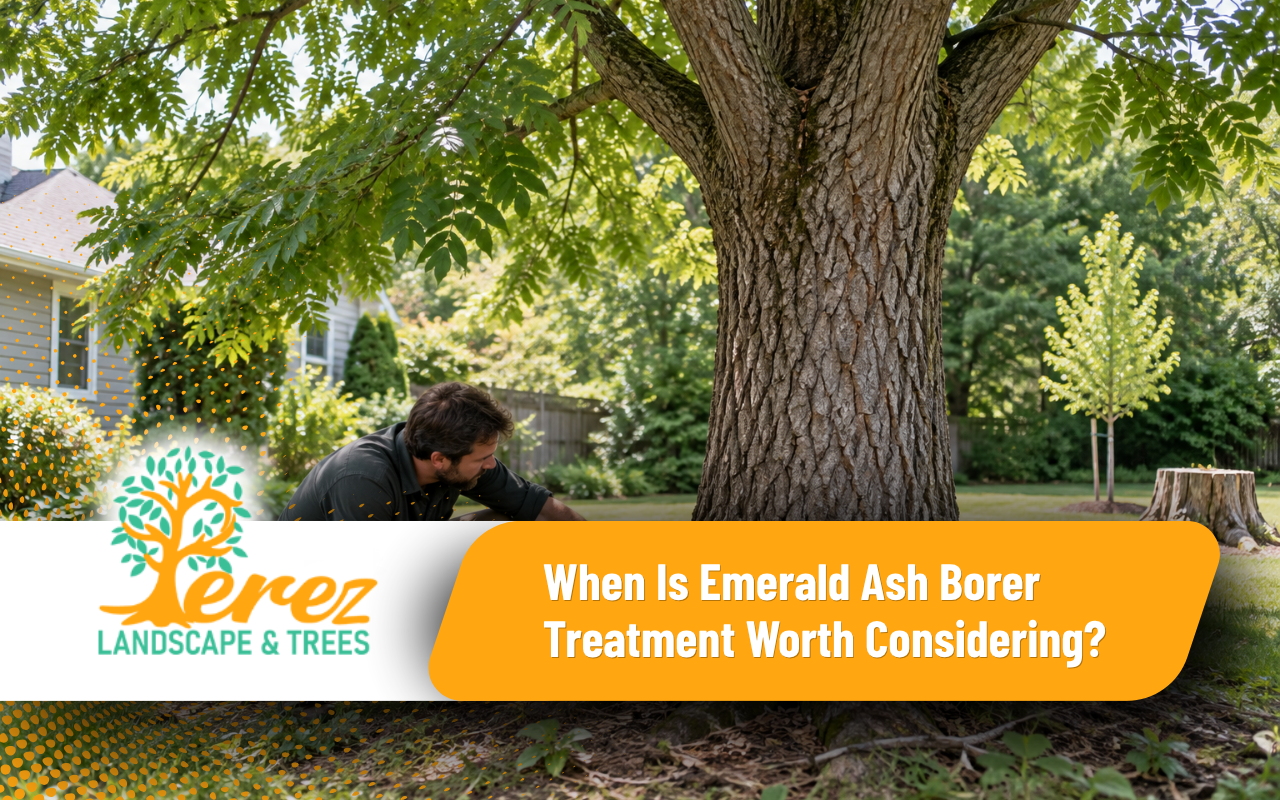
- Confirm the tree is an ash and assess its condition.
- Consider treatment for suitable trees before severe decline.
- Match application timing to the product, method, and label.
- Compare ongoing protection with removal and replacement.
- Keep people away from hazardous dead or failing trees.
A thinning ash canopy can leave you unsure whether saving the tree remains possible. At Perez Landscape and Trees LLC, we encourage you to separate diagnosis from the treatment decision.
Backed by more than 16 years of experience, our licensed team at Perez Landscape and Trees LLC offers free estimates for residential and commercial projects.
Review our assessing tree retention and removal and ask what the tree’s current condition allows before choosing a chemical product.
Assessing Emerald Ash Borer Treatment Before Choosing A Product
The treatment decision starts with identification and tree condition. A product cannot restore dead branches or resolve every structural defect. Confirm the tree is an ash, then assess whether its remaining canopy, trunk, and location make continued protection a reasonable goal.
The Missouri homeowner management guide uses a decision process that weighs tree health and suitability. Treatment does not reverse dead wood. A tree can require safety work even when an insect-control plan is appropriate.
Compare shade value and location with ongoing conflicts or severe damage. Our tree safety decision background helps frame the removal side of that comparison.
Ask which findings support the recommendation. Include emerald ash borer treatment in a defined retention plan.
Recording Symptoms Without Confusing Normal Autumn Leaf Loss
Symptoms need context because autumn leaf changes can obscure the difference between seasonal behavior and decline. Review summer photographs where available and inspect the tree from the ground. A bare canopy after normal leaf drop cannot by itself establish an emerald ash borer diagnosis.
- Note D-shaped exit holes where visible from the ground.
- Record bark splits or unusual woodpecker activity.
- Compare branch decline with earlier canopy photographs.
- Note shoots along the trunk or near the base.
K-State Research and Extension describes these emerald ash borer signs alongside the insect’s damage. Other stresses and insects can produce overlapping symptoms. Do not strip bark from a healthy tree or climb to collect evidence. Use ground-level photographs for the assessment.
Our background on seasonal tree pests provides a broader comparison. For noninsect concerns, our tree disease identification overview addresses a different topic. Do not treat every canopy problem as EAB. Correct identification prevents a product choice that fails to address the actual cause.
Matching Treatment Timing With The Selected Application Method
Treatment timing depends on the product, application method, tree condition, and local growing season. Systemic insecticides must move through the tree to reach the target pest. A generic autumn cleanup date does not establish the correct application window for every treatment option.
If you are deciding when to treat for emerald ash borer, consult a qualified applicator and the current label. Missouri’s homeowner guide describes early spring timing for certain soil treatments. Other methods may have different windows. Follow the current product label, rather than copying a date from an older general article.
At Perez Landscape and Trees LLC, we recommend using autumn observations to start the assessment and planning conversation. That does not mean every tree should wait until spring. A serious structural concern needs prompt review, while treatment timing requires its own product-specific decision.
Ask what method is proposed, why it fits the tree, and when repeat applications would be needed. Confirm the applicator’s qualifications for the work. Tree care experience does not establish pesticide authorization.
Comparing Continued Protection With Removal And Replacement Goals
Retention depends on the tree’s value and required care. Continued protection is different from a one-time repair. Compare the expected maintenance commitment with removal, replacement planting, and the loss of useful shade before making the choice.
Homeowners asking “is it worth saving an ash tree” need a site-specific answer. A suitable tree with limited decline may justify protection. A severely damaged tree or one in a poor location may not. Avoid guaranteed recovery claims, especially when extensive canopy loss already exists.
- Confirm identification and the extent of decline.
- Review the tree’s structure and nearby occupied areas.
- Request a treatment plan and repeat-care expectations.
- Compare removal and a suitable replacement species.
Our team at Perez Landscape and Trees LLC encourages you to discuss your ash tree concerns with photographs and the tree’s history. Ask separately whether specialist treatment is available. When comparing ash tree treatment in Kansas City MO, confirm the exact service and provider instead of assuming all tree companies perform insecticide work.
Planning Safe Next Steps For Dead Or Declining Ash
A declining ash near people or structures needs a safety decision alongside pest management. Dead branches and damaged wood can change the work involved. Keep activity away from an area of concern and arrange a review rather than attempting to remove large limbs yourself.
The Missouri guide recommends local disposal of removed ash material to avoid spreading the insect. Do not move suspect ash firewood casually. Confirm current disposal requirements with the relevant local authority or service provider.
With Perez Landscape and Trees LLC, you can discuss tree risk and removal needs through our planning around hazardous tree conditions. Explain whether branches extend over a driveway, roof, or other occupied space.
Insecticide cannot make a dead tree safe again. Plan the order of decisions carefully: establish condition, address hazards, then compare retention or replacement. Preserve records of the assessment so later recommendations can be understood in context.
Frequently Asked Questions
Can A Completely Dead Ash Tree Recover After Treatment?
No, insecticide cannot restore a dead tree or rebuild dead branches. The next decision concerns safe removal or another appropriate management option for the site. Keep people away from suspect branches and arrange a qualified review rather than buying a treatment as a repair.
Are Bare Branches In October Enough To Confirm EAB?
No, normal autumn leaf loss makes canopy diagnosis harder. Compare earlier photographs and review additional signs with a qualified person. Our recognizing different autumn pest concerns offers background, but several causes can produce decline and should not be treated as the same problem.
Does One Insecticide Application Protect An Ash Tree Permanently?
No, continued protection generally requires repeat treatment according to the product and recommended plan. Confirm the schedule and monitoring expectations before choosing retention. A one-time application should not be described as a permanent cure, especially where the tree already has significant damage or structural defects.
Should Every Ash Tree Be Removed Once EAB Is Nearby?
Not automatically. Suitable trees may be candidates for protection, while others may be better removed or replaced. Our reviewing ash tree safety factors helps frame the site decision. Compare condition, location, shade value, and the commitment required for continued care before choosing.
What Should I Ask A Provider Offering Ash Tree Treatment?
Ask about identification, the proposed product, label requirements, application method, qualifications, and repeat-care schedule. Share past treatments and signs of decline. Use our request guidance for ash tree concerns to discuss tree condition while confirming who would perform any specialist insecticide work.
Choosing An Ash Tree Plan Before Conditions Deteriorate
Choosing emerald ash borer treatment requires a decision based on tree condition and a realistic care plan. At Perez Landscape and Trees LLC, we encourage you to address safety concerns and confirm specialist treatment options early. Compare protection with replacement, then review your ash tree next steps before decline limits the choices available for your property.