
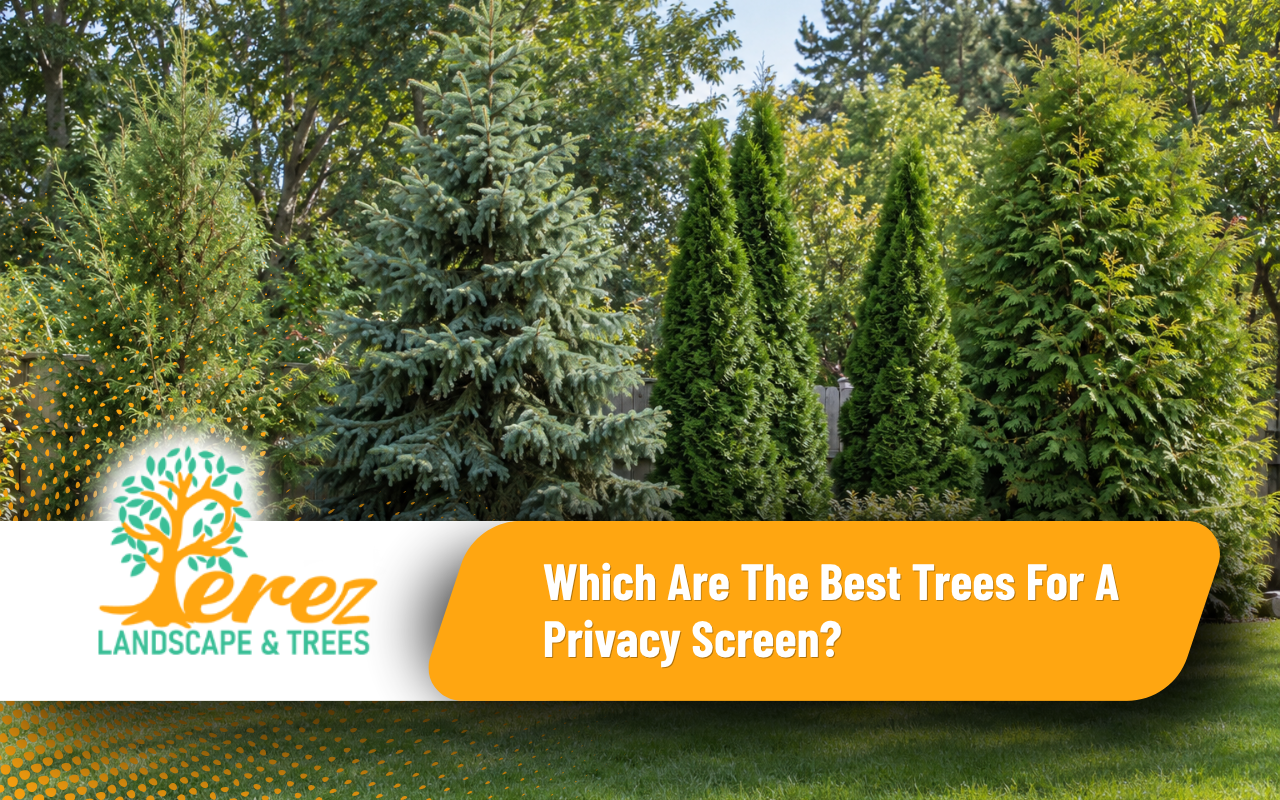
- Eastern redcedar can suit sunny, well-drained Missouri sites.
- Norway spruce needs enough room for its mature size.
- A suitable arborvitae cultivar can fit some narrower spaces.
- Mixed plantings reduce dependence on one species.
- Choose trees by mature width, site conditions, and the view to block.
An open view from a neighboring window can make a fast-growing tree sound like the perfect answer. At Perez Landscape and Trees LLC, we encourage you to measure the space first. Review our privacy planting and landscape options and consider the screen you need now and the mature planting you can maintain later.
Residential and commercial clients can count on us for 24/7 emergency service and a licensed crew.
Selecting The Best Trees For Privacy Screen Success
The best trees for privacy screen projects fit site and view. A plant that grows quickly but outgrows the bed may create a new conflict. Start with available width, sunlight, drainage, and the height needed for useful coverage.
Look from the seat, window, or doorway where privacy matters. Different sightlines may need shrubs or taller trees. Measure the actual viewing angle instead of selecting the tallest plant at the nursery.
Our custom planting layout support helps connect privacy goals with the wider yard. Keep space for paths, lawn care, and utilities. Preserve routine access.
- Identify whether winter coverage is essential.
- Note wet areas, shade, and exposed wind.
- Reserve space for the selected plant’s mature width.
- Confirm boundaries and restrictions.
We encourage a layout that remains useful as plants grow. The best trees for privacy must fit the site.
Comparing Evergreen Options For Different Missouri Yard Conditions
Evergreen options differ in mature size, growth habit, and site tolerance. Choose the specific species or cultivar, then verify its dimensions and growing needs rather than assuming all trees with the same common name behave alike.
The Missouri Department of Conservation’s “Windbreaks” includes red cedar and Norway spruce among planting options. Residential screens need their own spacing and layout. Do not copy farm windbreak spacing into a narrow yard.
| Option | Screen consideration | Before choosing |
|---|---|---|
| Eastern redcedar | Dense evergreen form for suitable sunny sites | Allow mature width and assess nearby plant compatibility |
| Norway spruce | Large evergreen structure where space permits | Verify room for full mature height and spread |
| Arborvitae cultivar | Dimensions vary greatly by cultivar | Check local suitability, width, and exposure |
| Mixed evergreen and shrub screen | Different layers can cover several sightlines | Coordinate light needs and maintenance access |
Our team at Perez Landscape and Trees LLC recommends comparing the plants that fit your site rather than choosing by a single growth claim.
Balancing Growth Speed With Long-Term Screen Maintenance Needs
Growth speed affects how soon a screen develops, but it does not replace site suitability. Water, soil, and establishment all influence progress. A fast-growing tree in an unsuitable location may need repeated cutting or replacement before it creates the intended privacy.
Searches for the fastest growing evergreen for privacy often overlook the final size. Ask what the plant will occupy when mature and how that affects nearby structures. Avoid promised annual growth as a guarantee. Nursery estimates describe potential performance under suitable conditions, not a fixed result for every yard.
If immediate coverage matters, compare larger planting stock, layered planting, or an appropriate nonliving screen. Do not crowd young trees simply to close the gap sooner.
At Perez Landscape and Trees LLC, we encourage you to distinguish visual privacy from sound control. A narrow row can block a view without meaningfully reducing traffic noise. Trees do not guarantee soundproofing. Describe both goals so the design does not promise a result that the available space cannot support.
Planning Tree Spacing From Mature Width And Sightlines
Spacing should reflect the mature width of the selected plant and the intended screen density. There is no single distance that works for every evergreen. A layout should also leave access for maintenance and avoid forcing trees against boundaries, structures, or utility corridors.
If you ask how far apart to plant privacy trees, begin with the exact cultivar. Its mature spread provides a starting point. Then adjust for the desired overlap, site limits, and whether the design uses one row or a staggered arrangement. Measure spacing between trunk centers.
- Mark the view that needs screening from the relevant location.
- Draw the mature plant footprints within the available bed.
- Check utility, structure, and access conflicts.
- Review the pattern before ordering the plants.
MU Extension’s “Residential Landscaping” emphasizes selecting and placing plants by mature size. Use that principle rather than a universal spacing chart. With Perez Landscape and Trees LLC, you can discuss a privacy screen layout and ask which plants remain practical within your yard’s measured dimensions.
Establishing A Fall Screen Without Neglecting Winter Care
Fall establishment of the best trees for privacy screen plans still requires care. Plant selection, stock condition, moisture, and exposure determine suitability. Evergreens keep foliage through winter, so a newly planted row should not be left without attention after the first cold nights.
Plan watering access before planting. Check the root ball and surrounding soil during dry conditions while the ground remains workable. Keep mulch away from direct trunk contact, and avoid placing a tree deeper merely to make it appear more stable.
When comparing a privacy tree planting service in Kansas City MO, ask for the species, cultivar, planting size, and care instructions. Clarify which parts of site preparation and installation are included. Ask which exact plants will fill the bed.
Review our residential planting project information. Check the layout from relevant sightlines. Keep maintenance space in the design, including room to reach fences and inspect the plants as the screen fills in.
Frequently Asked Questions
Which Evergreen Is Best For A Narrow Privacy Bed?
It depends on the bed width, sunlight, drainage, and exact cultivar. Some arborvitae selections may fit narrower spaces, but dimensions vary. Review our planning plants for limited spaces before choosing. A narrow planting strip may call for shrubs or another screening solution instead of trees.
Will Fast-Growing Trees Provide Complete Privacy Within One Season?
That cannot be guaranteed. Coverage depends on planting size, growth conditions, and the view you want to block. Compare the starting layout with the expected mature form. Avoid buying too many trees simply to force instant coverage in a bed they will later outgrow.
Should A Privacy Screen Use Only One Tree Species?
Not necessarily. A mixed screen can reduce dependence on one species and offer varied structure. However, the plants still need compatible conditions. Keep maintenance practical rather than adding many species without considering how their mature shapes will fit together.
Can A Row Of Trees Block Nearby Traffic Noise?
A typical narrow residential row should not be promised as effective noise control. It can screen the road visually, which is a separate benefit. Our outdoor design and screening guidance can help you describe the goal and compare practical features within the available space.
What Should I Provide Before Requesting A Privacy Planting Plan?
Provide bed measurements, photos from the relevant windows or seating area, sunlight conditions, and access limits. Note utilities and nearby structures. Send those details through our request privacy planting guidance so the discussion starts with the view and growing space rather than a generic tree list.
Building A Privacy Screen That Fits Your Property
Choosing the best trees for privacy screen goals requires more than a growth-rate comparison. At Perez Landscape and Trees LLC, we encourage measured layouts, suitable plants, and realistic coverage expectations. Protect space for mature growth and routine care, then plan your living privacy screen around the sightlines and conditions that matter most in your yard.