
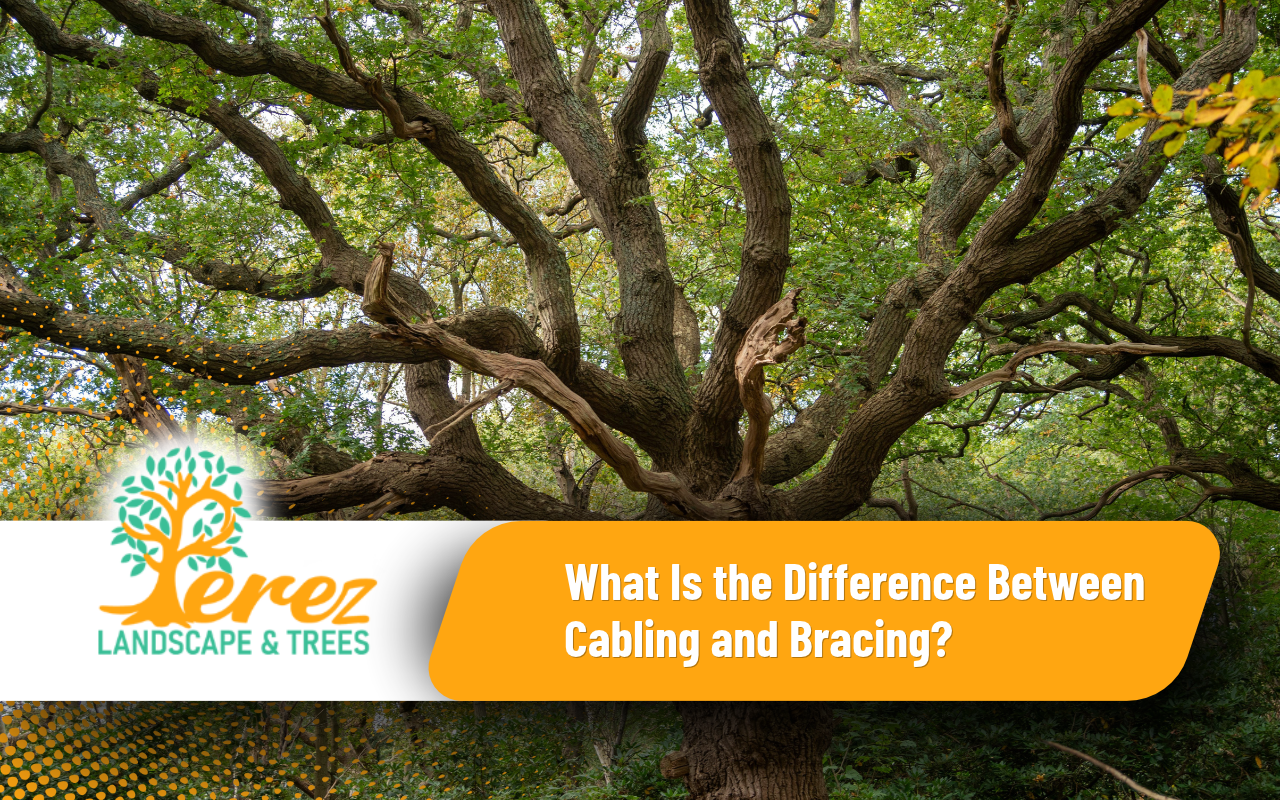
Cabling connects major limbs high in the canopy with steel or synthetic cable, so they share wind and ice loads. Bracing uses threaded steel rods installed through a weak union or split, lower in the tree, to hold the wood together.
| Method | Where it goes | Main purpose |
|---|---|---|
| Static cable | Upper canopy between limbs | Limits movement on weak forks |
| Dynamic cable | Upper canopy between limbs | Allows some sway while absorbing shock |
| Brace rods | Through the union or split | Holds wood together and resists twisting |
Many trees need both: rods at the weak point and cables higher up to reduce stress on it.
Saving a Weak or Split Tree With Cabling and Bracing
A big double-trunk maple can look healthy for years, then split down the middle in a single spring storm. Many of those failures start at a weak fork that was visible long before the crack appeared. If you have a tree with a tight V-shaped union or a fresh split, you can request a cabling assessment and a free estimate.
Tree cabling and bracing adds support to weak parts of a tree so it can stay standing safely. The answers below explain how the systems work, when they help and when removal is the safer choice.
How Does Tree Cabling Work Inside a Mature Canopy?
A cable is anchored into each limb, usually about two-thirds of the way up from the weak union. When wind pushes one limb, the cable transfers part of that load to the other, so the fork is not pulled apart. The tree keeps growing normally around the hardware.
Tree cabling and bracing works best as prevention. Installing support before a fork cracks is simpler and more reliable than trying to close a split after a storm.
Installation follows industry standards so the hardware does not girdle limbs or create new weak points.
Can a Split Tree Be Saved With Cabling?
Sometimes. A fresh split in a healthy tree with sound wood can often be closed with brace rods and supported with cables. A split with decay, a large lost section or a dying canopy usually cannot be saved safely. To find out where your tree stands, you can check if cabling works with our licensed crew.
Acting fast matters. A split that stays open lets water and decay into the wood, which lowers the chance of a good repair.
Which Trees Are Good Candidates for Support Systems?
The best candidates are healthy, valuable trees with a specific structural weakness that can be supported. Trees that are already declining rarely benefit.
- Co-dominant trunks with a tight V-shaped union
- Included bark trapped inside a fork
- Long, heavy limbs extending over roofs or driveways
- Recent splits in otherwise healthy wood
- Historic or shade trees worth preserving
At Perez Landscape and Trees LLC, we look at the whole tree before recommending hardware. A strong root system, healthy canopy and sound wood around the weak point are signs that support will be worth it.
When Is Removal Safer Than Cabling a Weak Tree?
Removal is often safer when the trunk has major decay, the root system is damaged or the tree leans heavily toward a home. Cabling supports weak forks, but it cannot fix a failing base. Our guide on leaning tree risk solutions explains when a lean becomes dangerous.
A professional inspection weighs the tree’s condition against what it could hit if it failed.
What Affects Tree Cabling Cost on a Residential Property?
Cost depends on tree size, the number of cables or rods, how high the crew must climb and whether pruning is needed at the same time. Easy access and a single cable cost less than complex systems in large trees over homes. A written estimate should list each piece of hardware and any pruning planned with it.
- Number and type of cables or brace rods
- Height and spread of the canopy
- Access for climbers or lifts
- Reduction pruning to lighten heavy limbs
- Follow-up inspections over the years
How Often Should Cables and Rods Be Inspected?
Most systems should be checked about once a year and after major storms. Inspectors look at cable tension, hardware wear and whether the tree has grown around anchors. Our tree risk assessment process includes these checks.
Overgrown limbs add weight that cables must carry. Our article on the risks of overgrown branches shows why light pruning often goes with cabling.
Who Provides Tree Cabling Service in Kansas City, MO?
Our team at Perez Landscape and Trees LLC installs cabling and bracing for homes and commercial properties across the Kansas City area. With more than 16 years of experience, we combine support systems with pruning so trees carry less weight. We also offer 24/7 emergency service when a split happens during a storm.
Frequently Asked Questions
Does cabling hurt the tree?
Properly installed hardware causes small wounds that the tree usually seals over time.
How long do tree cables last?
It varies by material and tree growth, so regular inspections decide when adjustment or replacement is needed.
Can cabling prevent all failures?
No. It reduces risk on weak forks but cannot guarantee a tree will never fail.
Is cabling done in winter?
It can be done year-round, and winter often makes the structure easier to see.
Do you offer free estimates?
Yes. Free estimates are available for cabling, bracing and inspections.
Protecting Valuable Trees Without Removing Them
Tree cabling and bracing can add years to a tree with a weak fork or a fresh split, as long as the wood is healthy. Regular inspections keep the system working. At Perez Landscape and Trees LLC, every recommendation weighs safety first.
Call (816) 315-1508 or book tree cabling service before the next storm season.