
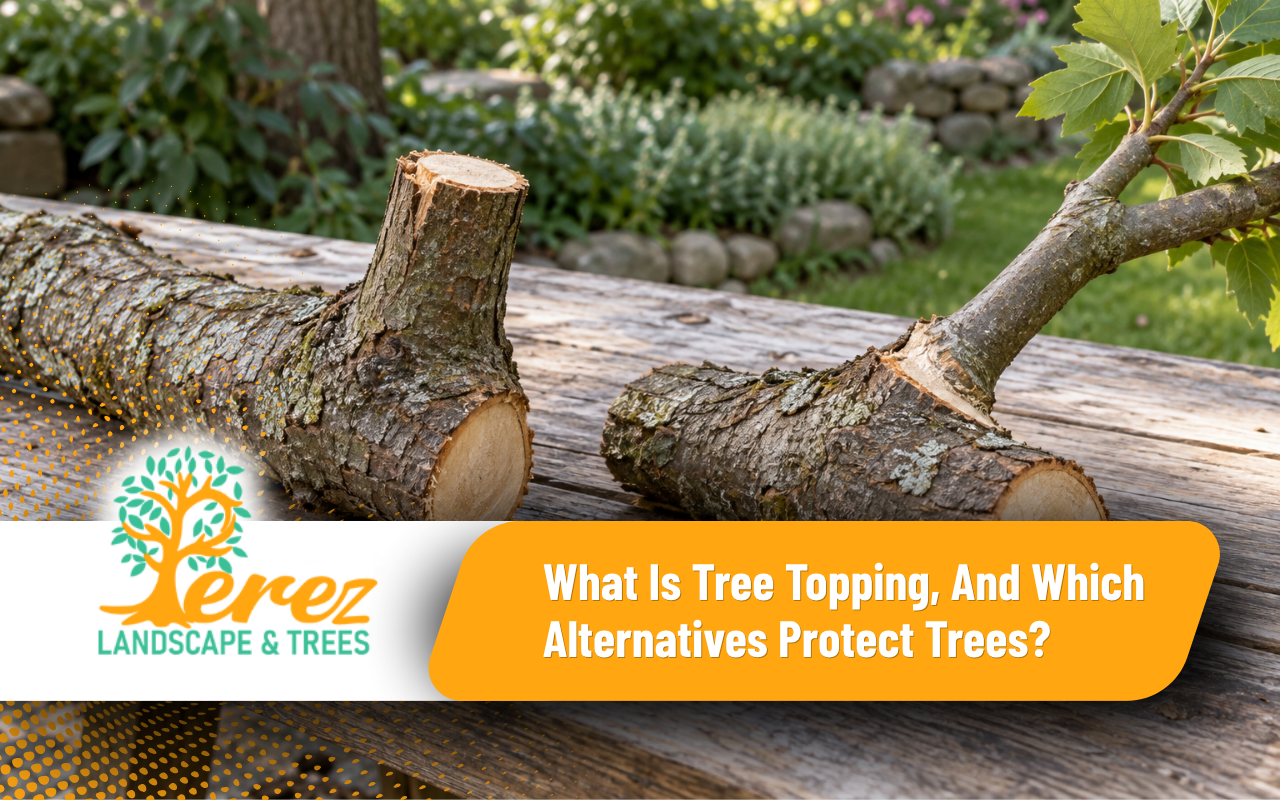
- Tree topping cuts branches to stubs or unsuitable small laterals.
- It can cause stress, decay, and weakly attached regrowth.
- Crown reduction shortens suitable branches to appropriate laterals.
- Some trees cannot safely meet the requested height limit.
- Ask a qualified arborist about selective pruning or replacement.
Branches near a roof can make a shorter tree seem safer before winter. At Perez Landscape and Trees LLC, we encourage you to focus on the actual clearance problem. Review our Independence tree trimming options and ask about a defined pruning goal instead of requesting a flat cut across the canopy.
Topping removes substantial branch ends without respecting suitable branch connections or the tree’s natural structure. Property owners often consider it when a tree appears too tall. Understanding the practice helps separate harmful size cutting from targeted pruning that addresses a specific conflict while preserving as much healthy structure as possible.
Understanding What Is Tree Topping In Practical Terms
The defining feature of topping is the cut location, not simply a shorter tree. Cuts leave stubs or return branches to laterals too small to take over growth. Understanding what is tree topping helps you evaluate a proposed pruning result before work begins.
The International Society of Arboriculture’s “Why Topping Hurts Trees” describes the practice and its risks. Topping may produce a sharply lowered silhouette, but that appearance does not establish better tree health or stability. A smaller canopy can still be unsafe.
Look for bare stubs or a flat top that ignores the natural branching pattern. Our understanding clean pruning cuts provides related background on cut quality. However, a smooth cut in the wrong place still creates a problem.
Ask whether each cut serves a clear purpose; height alone cannot define the plan.
Recognizing Why Severe Cuts Can Increase Future Problems
Severe cutting removes leaves and changes the tree’s structure at the same time. The response may include rapid shoots around damaged branches. That new greenery can appear reassuring, even while attachment problems or decay remain hidden within the old cutting sites.
- Rapid regrowth is not proof of recovery.
- Large wounds can create long-term decay concerns.
- Repeated topping can continue the damage cycle.
- A previously topped tree needs its own assessment.
Why topping is bad for trees involves more than appearance. The ISA brochure explains that new shoots can attach weakly and become vulnerable to failure. University of Missouri Extension also warns that excessive pruning removes important leaf area and stored resources.
Our team at Perez Landscape and Trees LLC recommends keeping winter preparation focused on actual defects. Height alone does not establish risk. Tell us about branch contact, visible damage, or earlier topping when you ask about the next step.
Comparing Crown Reduction With Topping For Specific Clearance
Crown reduction addresses selected height or spread conflicts through suitable branch connections. It preserves a working framework instead of leaving arbitrary stubs. The method still requires judgment, and some trees cannot tolerate enough reduction to meet the owner’s requested clearance.
| Decision point | Crown reduction | Topping |
|---|---|---|
| Cut location | Selected suitable lateral branch | Stub or unsuitable small lateral |
| Intended result | Targeted clearance with retained structure | Broad height reduction without sound structure |
| Future care | Follow-up based on tree response | May require correction or removal |
The crown reduction vs topping comparison should lead to a tree-specific plan. Ask which branches will change and what clearance is realistic.
At Perez Landscape and Trees LLC, we encourage you to ask about canopy clearance before requesting a fixed amount off the top. Describe the obstruction first. A limb over a driveway may need a different solution from a tree that has outgrown the entire planting space. The best answer may involve selective pruning, redesign, or replacement.
Matching Height Concerns With A Realistic Pruning Objective
A useful pruning objective states the problem the work should solve. Roof contact, driveway clearance, and a damaged branch are different concerns. Choosing the objective first allows a professional to explain whether pruning can address it without creating larger wounds or structural problems.
- Identify the branch or feature causing the conflict.
- Share any past pruning, storm damage, or visible defects.
- Ask which targeted clearance cuts are feasible.
- Compare retention with replacement if the site cannot fit the tree.
If you are researching how to reduce the height of a tree, remember that thinning does not directly lower its top. Removing lower branches raises clearance beneath the crown; it also does not lower tree height.
For tree trimming in Independence MO, use our local canopy care information to begin a service discussion. Keep work near power lines with the appropriate utility professionals. Do not approach wires or attempt elevated cutting because a branch appears within easy reach.
Scheduling Follow-Up Care Without Repeating The Original Damage
Care after pruning depends on the tree’s condition and the work performed. A previously topped tree may require a restoration plan rather than another severe cut. Review structure over time, and keep records of changes that could affect the next assessment.
MU Extension’s “Pruning and Care of Shade Trees” explains that established shade trees do not all require pruning on a fixed schedule. The same interval should not be prescribed for every species or yard. Our planning species appropriate pruning offers related timing considerations without replacing the individual tree review.
With Perez Landscape and Trees LLC, you can discuss the concern that prompted the height request and ask what follow-up is appropriate. Photograph the tree and concerns from the ground. Do not remove healthy branches merely to match a calendar.
The answer to what is tree topping should help you recognize an avoidable practice.
Frequently Asked Questions
Does A Shorter Tree Always Resist Winter Storms Better?
No, a shorter silhouette does not establish stronger structure. Severe cuts may leave defects or weak regrowth. A tree assessment should consider its branches, trunk, roots, and surroundings. Focus on specific concerns rather than assuming height reduction alone makes a tree suitable for winter.
Can Crown Reduction Make Any Large Tree Much Shorter?
No, the amount of suitable reduction depends on species, branching, condition, and available lateral branches. Some height goals cannot be met without excessive damage. Discuss the realistic result before work begins, including whether replacing the tree would better address a permanent space conflict.
Should An Already Topped Tree Be Topped Again Later?
Repeated topping is not an appropriate repair strategy. A qualified arborist should evaluate existing stubs, decay, and regrowth before suggesting restoration or removal. Our pruning cut quality background explains related principles, but correcting old damage requires a plan for that particular tree.
When Should I Arrange Pruning Before Winter Weather Arrives?
Arrange a review when you notice defects or a meaningful clearance conflict. The appropriate cutting season depends on species and the work needed. Our seasonal canopy care guidance can help frame the conversation without treating autumn as the correct pruning time for every tree.
What Should I Ask Before Approving A Trimming Proposal?
Ask which branches will change, the purpose of each major cut, and whether the tree can meet your clearance goal. For local work, review our Independence pruning service details. Request an explanation of the finished structure rather than approving a vague promise to shorten everything.
Keeping Winter Tree Decisions Focused On Sound Structure
Knowing what is tree topping helps you question a quick height reduction that may create future problems. At Perez Landscape and Trees LLC, we encourage clear pruning objectives and realistic alternatives. Protect the tree’s useful structure where possible, then discuss your tree clearance concern before approving cuts intended to prepare your yard for winter.