
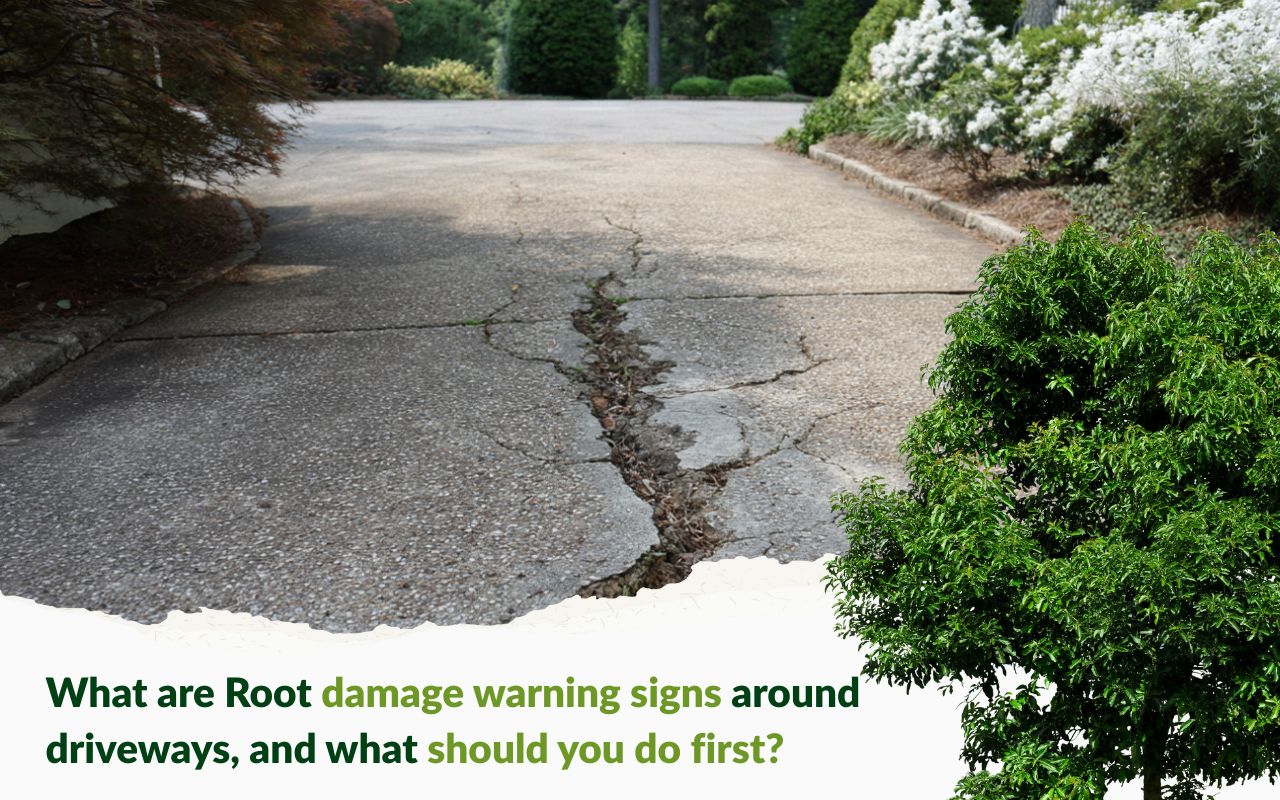
Driveway damage often starts underground. Therefore, learning Root damage warning signs around driveways helps you act early. Small cracks and bumps can grow fast. However, you can spot patterns before repairs get expensive. Use this guide to check edges, joints, and nearby sidewalks. Then, protect your hardscape and your trees.
What are Root damage warning signs around driveways, and what should you do first?
Root damage warning signs around driveways include uneven slabs, widening cracks, and shifting joints. Additionally, you may see lifted edges, puddling, and soil movement near borders. First, document the area and reduce water near the slab. Then, get a professional assessment to protect both the driveway and the tree.
Why roots disturb concrete and asphalt near a driveway
Roots search for water and oxygen. As a result, they often grow close to the surface. Over time, they press against base layers and create movement. Therefore, Root damage warning signs around driveways can appear slowly.
- Roots expand in diameter each season, which increases upward pressure.
- Compacted soil pushes roots toward the surface instead of deeper routes.
- Moisture near edges attracts roots, especially near sprinklers and downspouts.
- Freeze and thaw can widen small cracks after roots create the first lift.
In Kansas City, weather swings can speed changes. Therefore, Perez Landscape and Trees LLC recommends routine checks after wet seasons.
How to spot surface changes before the damage spreads
Start with a slow walk and look from different angles. Then, check the driveway when it is wet. Puddles can reveal low spots and shifting slopes. These checks help confirm Root damage warning signs around driveways.
- Hairline cracks that keep returning after sealing.
- Raised ridges crossing the driveway, especially near tree lines.
- One slab sitting higher than the next along control joints.
- Water pooling where runoff used to drain cleanly.
Also, listen for hollow sounds when tapping near a crack. That can suggest soil movement below.
Heaving soil clues and sidewalk lifting indicators that often appear together
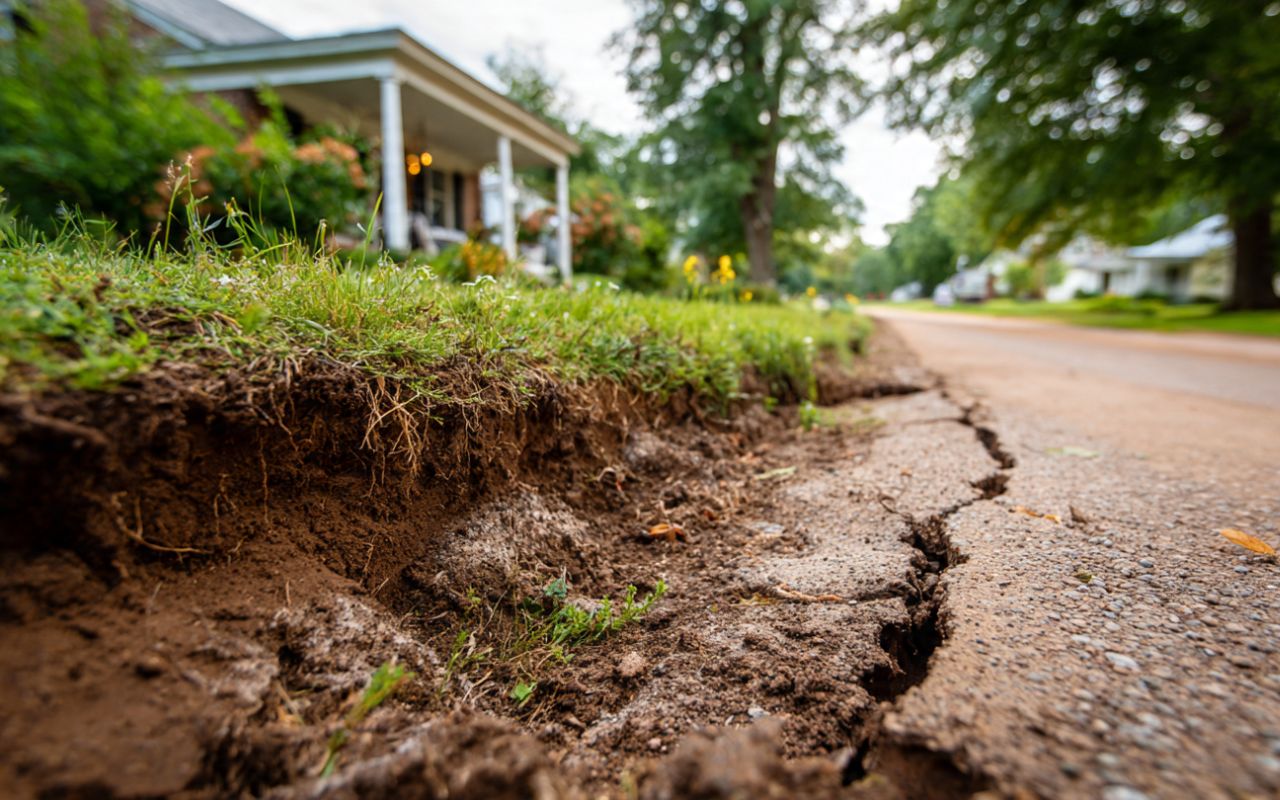
Look beyond the driveway surface. Often, the landscape nearby shows early movement. For example, Heaving soil clues can show as raised earth along edges. Meanwhile, Sidewalk lifting indicators may show as tilted panels and widened seams.
- Raised soil mounds near the driveway border.
- Mulch lines that look pushed upward after rain.
- Sidewalk joints that no longer align with the next slab.
- Trip lips that form where a walkway meets the driveway apron.
If you spot both sets of clues, Root damage warning signs around driveways are more likely. Therefore, act sooner instead of later.
Risk factors that make Root damage warning signs around driveways more likely
Risk depends on tree species, soil, and water patterns. Therefore, a quick risk scan can prevent surprises. Perez Landscape and Trees LLC often sees issues where trees are planted too close. Additionally, irrigation habits can pull roots toward the slab.
Pay extra attention when:
- Trees are within about ten feet of the driveway edge.
- Clay soil keeps water near the surface for long periods.
- Downspouts dump water beside the driveway.
- Sprinklers soak the driveway border every day.
Also, watch for recurring shade and moss near joints. That can signal persistent moisture.
How to manage root pressure safely without harming the tree
DIY root cutting can be risky. Therefore, choose methods that balance safety and tree health. Perez Landscape and Trees LLC focuses on targeted solutions that protect structural roots. In many cases, Root-safe trimming service in Kansas City is the best next step.
Common professional options include careful root pruning, barrier installation, and moisture control. Additionally, repair planning should match the driveway material and the root layout.
How to check and respond step by step
Use this simple process to reduce risk and organize next actions. Then, share your notes with a professional for faster diagnosis. This approach supports early action on Root damage warning signs around driveways.
- Photograph cracks, lifted edges, and puddles from two angles.
- Mark the ends of cracks with chalk to track growth over time.
- Check nearby walkways for Sidewalk lifting indicators.
- Look for Heaving soil clues along the driveway border.
- Redirect sprinklers away from the slab edge for two weeks.
- Schedule a professional evaluation to plan safe mitigation.
For proactive pruning, use a local team with proven cleanup and safety standards. You can explore trimming support through Tree Trimming in Grandview, MO Local Tree Services.
FAQs about driveway root concerns
Can Root damage warning signs around driveways also signal tree health problems?
Yes, sometimes. Root stress can appear in canopy thinning or lean changes. Therefore, pair driveway checks with tree health checks. For deeper root symptom guidance, review Root Damage Indicators That Signal It’s Time to Take Action.
What should I do if my driveway starts pooling water after rain?
First, note where the water sits and how long it lasts. Then, check for nearby lifting and crack widening. Because water invites roots, correct drainage early. If grading or beds need help, see Landscaping Services in Kansas City, MO, Trusted Company.
Is it safe to cut roots that are lifting a slab?
Not always. Cutting the wrong roots can destabilize the tree and increase risk. Therefore, get a professional plan before any cuts. A trained team can coordinate pruning and protection using Tree Trimming in Grandview, MO Local Tree Services.
How can I tell if the problem is roots or soil settlement?
Roots often create localized lift near a tree line, plus Heaving soil clues. Settlement often creates broader dips and recurring puddles. However, both can overlap. For common root patterns and timing, read Root Damage Indicators That Signal It’s Time to Take Action.
How do I get a site-specific plan without guessing?
Get an on-site assessment with clear options. That way, you protect the driveway and the tree. Perez Landscape and Trees LLC can review risks and recommend next steps. Start through Contact Perez Landscape and Trees LLC in Kansas City, MO.
When to call Perez Landscape and Trees LLC for help
If Root damage warning signs around driveways are growing, act quickly. Small cracks can spread, especially with water and freeze cycles. Therefore, schedule expert help before the slab shifts further. Perez Landscape and Trees LLC can guide safe pruning, moisture changes, and next-step planning. To begin, use Contact Perez Landscape and Trees LLC in Kansas City, MO.
Also, if you want long-term yard coordination, Perez Landscape and Trees LLC can align planting beds and drainage. Consider a full outdoor plan with Landscaping Services in Kansas City, MO, Trusted Company.
References
How To Deal With Tree Roots That Are Making A Mess Of Your Yard (Southern Living)
What to Do About a Sidewalk Damaged By Tree Roots (Today’s Homeowner)