
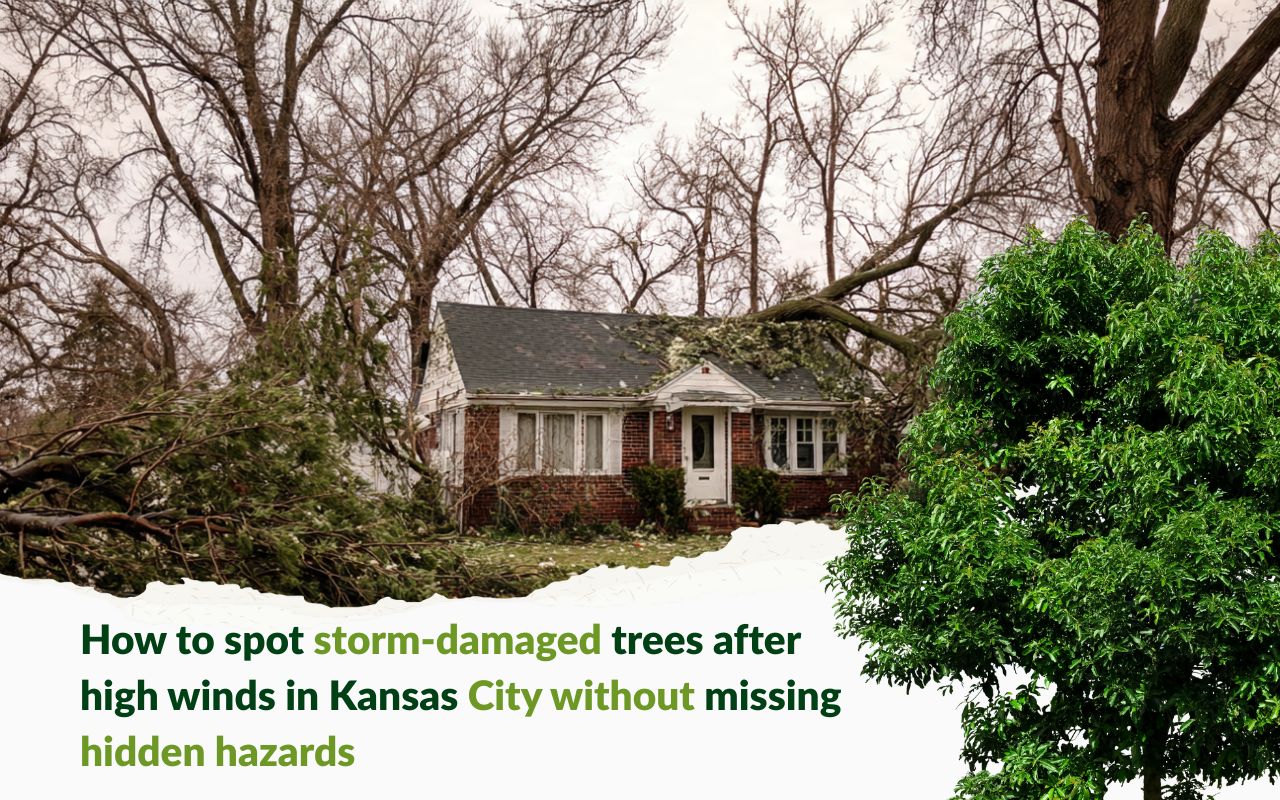
After strong winds, trees can look fine yet hide serious damage. Because failures often happen later, a quick, smart check matters. This guide explains how to spot storm-damaged trees after high winds in Kansas City, including cracks, root shift, and canopy hazards. You will also learn when to call for fast help.
To spot storm-damaged trees after high winds in Kansas City, start at the ground, then scan the trunk, and finally look into the canopy. Next, watch for fresh leaning, exposed roots, and new cracks. Also check limb unions for split crotches. Finally, use binoculars to find hanging limbs you can’t see from ground.
What visible storm damage looks like in your yard
First, walk the area and stay alert for downed branches. Then, look for fresh wounds that appeared after the wind. Because new damage can invite decay, note every change.
- Broken limbs with jagged ends, especially near walkways or driveways
- Stripped bark or long scuffs on the trunk
- Gaps in the crown where leaves or branches are suddenly missing
- Bark chips and twigs scattered at the base of the tree
- Soil cracks or lifted turf near the root flare
As you document signs, take photos from two angles. Afterward, compare them after the next windy day. If changes continue, treat the tree as unstable.
For more storm response guidance, review Storm-damaged trees: what to do in Kansas City from Perez Landscape and Trees LLC.
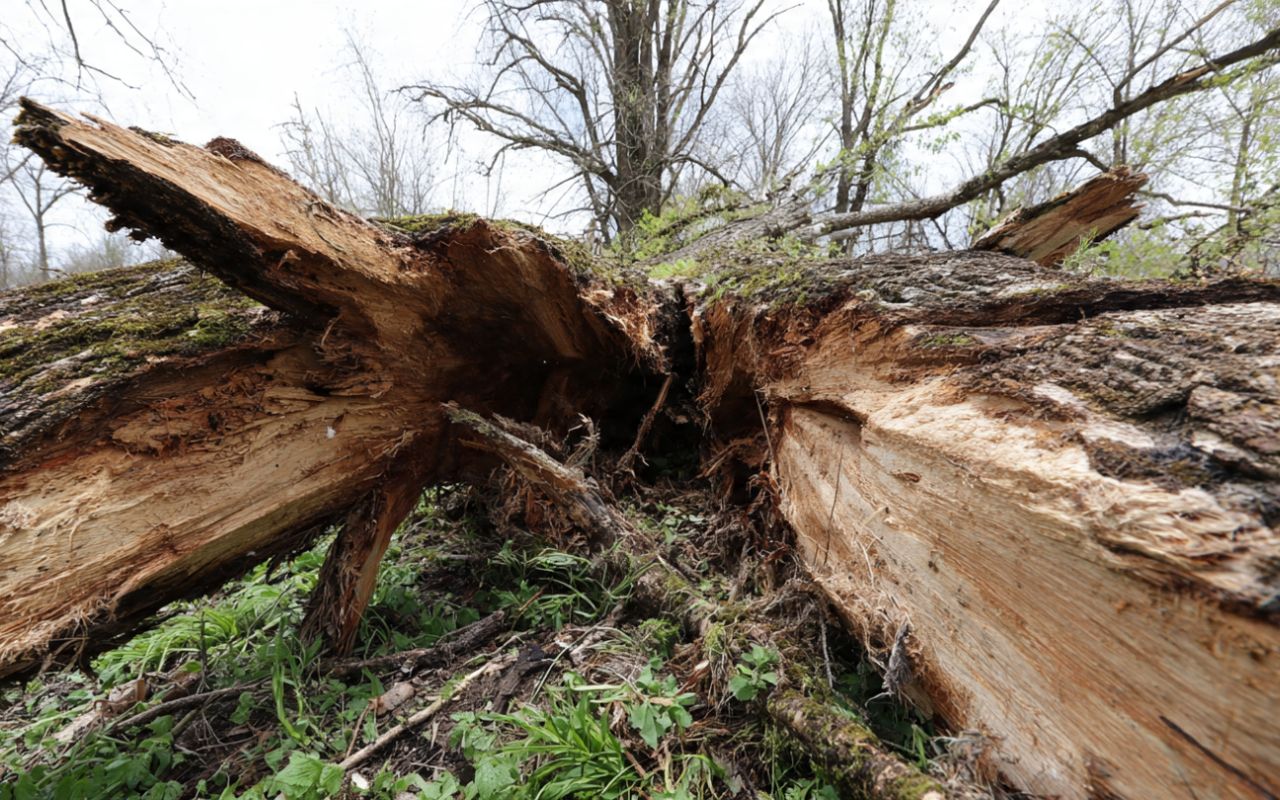
Even when a tree stands tall, internal stress can be severe. Therefore, spend time looking for subtle clues. If you want to know how to spot storm-damaged trees after high winds in Kansas City, these hidden issues matter most.
- Split crotches where two large stems meet, especially with raised bark
- Hairline cracks with sap seepage along branch unions
- Sudden canopy thinning on one side, which can signal internal breakage
- Soft, dark wood under loose bark, which may indicate rot
- Freshly exposed roots that reduce anchoring strength
Also remember that split crotches can open wider with each gust. Because of that, early action prevents sudden drops. If you need more examples, use Storm-Damaged Trees Signs You Should Never Ignore from Perez Landscape and Trees LLC.
Why hanging limbs are the most overlooked danger
Hanging limbs you can’t see from ground can sit high and still look “attached.” However, they may be held only by splinters. That is why a quick upward scan is essential.
Use binoculars and look for limbs that sway differently than the rest. Then, listen for creaks during light breezes. If you suspect hanging limbs you can’t see from ground, keep people away below. Next, plan professional removal rather than a DIY cut.
How to inspect trees safely after high winds
Before you start, prioritize safety over speed. Then, follow a consistent process each time. This is the simplest way to spot storm-damaged trees after high winds in Kansas City with fewer mistakes.
- First, check for downed wires and keep a wide distance.
- Next, walk the drip line and look for soil heaving or cracks.
- Then, scan the trunk for new splits, seams, or sunken bark.
- After that, inspect major unions for split crotches and sap stains.
- Finally, use binoculars to find hanging limbs you can’t see from ground.
Also avoid standing under damaged canopies while it is windy. If the tree rocks when you push lightly, step back immediately. At that point, treat it as urgent.
FAQs about post-storm tree safety in Kansas City
What should I do first after I think a tree was damaged?
First, keep people and pets away from the area. Then, document the damage with photos. Afterward, follow the steps in Storm-damaged trees: what to do in Kansas City. If the tree threatens a home, act faster.
How can I confirm a tree is unstable if it is only slightly leaning?
Compare today’s lean to photos from before the storm. Next, check for soil lifting on one side. Also look for root exposure and new trunk cracks. If you are unsure, schedule Arborist Inspection in KC and When to Schedule Tree Removal.
Are split crotches always an emergency?
Not always, yet they are high-risk after wind. Because included bark can weaken unions, cracks may spread quickly. If you see split crotches widening, avoid the area. Then, request an expert assessment through Perez Landscape and Trees LLC.
How do I handle hanging limbs I cannot see clearly?
Use binoculars and look from multiple angles. However, do not climb or cut overhead limbs yourself. Because hanging limbs you can’t see from ground can fall without warning, call a trained crew. If urgent, review Emergency Tree Removal and When It Becomes Necessary.
When should I search for emergency tree removal near me in Kansas City?
Search for emergency tree removal near me in Kansas City when a tree is leaning toward a structure, blocking access, or dropping large limbs. Also act fast if roots are lifting or the trunk is splitting. In those cases, use Contact to reach Perez Landscape and Trees LLC.
When to call Perez Landscape and Trees LLC for help
If you are learning how to spot storm-damaged trees after high winds in Kansas City, know when the risk crosses the line. Therefore, call for help when hazards are structural, elevated, or near buildings. Perez Landscape and Trees LLC can evaluate, prune, brace, or remove trees safely.
- Lean increased after the storm, or the tree rocks in the soil
- Split crotches, trunk cracks, or major bark separation appeared
- Hanging limbs you can’t see from ground are suspected
- Roots are exposed, or the ground is lifting around the base
- You need emergency tree removal near me in Kansas City fast
For nearby removals and planning, see Tree Removal in Lee’s Summit, MO Tree Service Pros. Then, reach out to Perez Landscape and Trees LLC using the Contact page for a post-storm check.
References
For additional storm-related tree safety context, see these editorial sources:
- After recent storms, now is a good time to get your trees checked for fractures
- In the aftermath of a storm, will a damaged tree survive?